Reviewed by Nadia Chow, Registered Dietitian
If you’ve just been told you have diabetes, you’ve probably also been handed a long list of things you’re “not allowed” to eat. Rice. Noodles. Anything sweet. It can start to feel like the rest of your life will be one long, boring salad.
It doesn’t have to be. And the science doesn’t say it should be.
You’re also far from alone. According to the Department of Health’s latest Population Health Survey, about 8.5% of people in Hong Kong aged 15–84 have diabetes or raised blood glucose, and more than a third of them don’t know it yet.
Good diabetes nutrition comes down to three things: the type of carbs you eat, how much you eat at each meal, and when you eat. Most people understand this after one appointment with their doctor. Actually doing it, with a Hong Kong work schedule, lunch from a cha chaan teng and no idea what’s in the sauce, is the hard part.
This guide covers what the research says, how everyday Hong Kong foods like rice, noodles and dim sum fit in, and what to look for in a diabetic meal plan or delivery service.
This article is general information, not medical advice. Always agree your targets with your doctor or dietitian, especially if you take insulin or medication that can cause low blood sugar.
A diabetic diet isn’t about cutting everything out
Ask someone newly diagnosed what they can’t eat any more, and the answer comes quickly: carbs, rice, dessert. It’s an understandable reaction, but it’s out of date, and it tends to backfire. Diets built on “never again” are hard to keep up.
The International Diabetes Federation recommends balanced meals built around slow-release, high-fibre carbs, lean protein and plenty of vegetables, with consistent portions and meal times. Hong Kong’s Centre for Health Protection gives similar advice. Nobody is telling you to give up rice for good.
There’s a practical difference here too. If your diet feels like punishment, you’re running on willpower, and willpower runs out. If you understand why a bowl of brown rice with fish and vegetables gives you a steadier reading than a plate of white rice with sweet-and-sour pork, you’re running a system. And you can see it working on your glucose meter.
Carb counting: still the most reliable method
Out of all the approaches doctors and dietitians use, carbohydrate counting has the strongest track record. A 2023 review in Cureus found it gives better blood sugar control and more flexibility than other meal-planning methods, for both type 1 and type 2 diabetes. A 2025 meta-analysis reached a similar conclusion.
Carb counting doesn’t ban carbs. It tracks them in grams, meal by meal. A bowl of noodles isn’t the problem. A bowl of noodles when you have no idea how many grams of carbs are in it is.
That’s also why it’s easier to stick with than strict avoidance: you can still eat the food you grew up with, as long as you know how much is on the plate. We’ve covered the basics in more detail in counting your carbs to manage diabetes.
The catch? It only works if the numbers are right. At home, with a kitchen scale and labelled packets, that’s manageable. At a Hong Kong food court, it’s almost impossible. More on that below.
Glycaemic index and glycaemic load, in plain English
Carb counting tells you how much. The glycaemic index (GI) helps you choose which carbs.
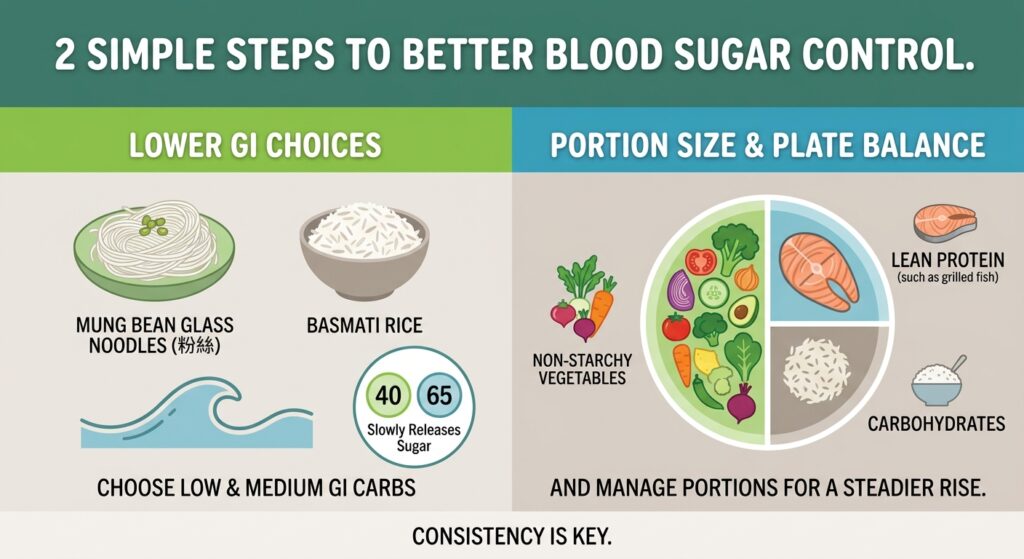
GI ranks carb foods from 0 to 100 by how fast they raise your blood sugar. 55 or below is low GI; 70 or above is high. Low-GI foods release sugar slowly, so you get a gentle rise instead of a spike. If you want the full explanation, read our post on what the glycaemic index is.
Glycaemic load (GL) adds portion size into the picture. A medium-GI food in a small portion can have a low GL. So halving your rice doesn’t just cut calories, it cuts the blood sugar impact of the whole meal. That’s why portion size and carb quality work together.
An international scientific consensus confirms that choosing lower-GI carbs reduces blood sugar rises after meals. A 2020 review in Nutrients found low-GI diets help lower HbA1c in type 2 diabetes. It also warned that GI alone isn’t enough: you still need to watch the amount of carbs in each meal.
In practice, you don’t need to memorise a GI table. Build each meal around:
- a low-to-medium GI carb (and a sensible portion of it)
- a good serving of protein
- plenty of fibre from vegetables
- a little healthy fat, like olive oil, avocado or nuts
Protein, fibre and fat all slow down how quickly your stomach empties, which softens the blood sugar rise. The whole plate matters more than any single swap.
Rice, noodles and dim sum: GI of common Hong Kong foods
Here’s how some local staples compare. Values are approximate and vary by variety and cooking method; the International GI Tables (2021) are the standard reference.
Rice
Boiled white rice usually sits around 70 or higher, and fragrant jasmine rice can be higher still. Brown rice is lower, but often only by a little, typically somewhere in the 60s. Basmati and parboiled rice tend to come in lower.
So the swap to brown rice helps, but it isn’t magic. What matters more is how much rice is on the plate and what you eat with it. Two simple tricks worth trying:
- Eat your vegetables and protein first, rice last. Studies on “food order” show this can noticeably lower the blood sugar spike from the same meal.
- Cooked and cooled rice (for example, reheated leftovers) forms some resistant starch, which is digested more slowly. It’s a small effect, but it’s free.
Noodles
Noodles vary more than any other staple. Mung bean glass noodles (粉絲) are among the lowest-GI options you’ll find, at around 40. Rice noodles and udon usually land in the medium range. Instant noodles and some rice-based noodles can be much higher. Picking your noodle is one of the easiest wins at any meal, and hardly anyone thinks about it.
Dim sum
Dim sum is the hardest to judge. Wrapper thickness, filling, frying versus steaming and hidden sugar in the sauces all change the result, and you can’t see any of it from the trolley. Steamed, protein-heavy items like har gow or steamed fish are usually safer bets than cheung fun, lo mai gai or anything sweet and fried. Portion size and what else is on the table matter a lot.
Meal timing: the part most people ignore
Even a well-built, low-GI meal won’t do its job if your meal times are all over the place.
Skipping breakfast, eating lunch at 3pm and having dinner at 9:30pm is a very normal Hong Kong day. For blood sugar, it’s a tough one. Long gaps followed by big, late meals tend to cause bigger spikes and make overeating more likely. The IDF and most diabetes guidelines recommend regular, evenly spaced meals, and if you’re on insulin or certain tablets, consistent timing also lowers your risk of hypos.
Breakfast deserves extra attention. A balanced breakfast with protein and a moderate amount of carbs can soften your blood sugar response at lunch too. Researchers call this the “second meal effect.” Yet breakfast is the meal most often skipped here, or replaced with a pineapple bun and milk tea on the way to the MTR.
This is one place where meal delivery helps in a way people don’t expect. When your food turns up at the same time every morning, you have a built-in routine. You don’t need to remember to eat properly; the meal is already on your desk.
Why knowing what to eat isn’t enough
Most people with diabetes can tell you the rules. They know brown rice beats white rice. They know their HbA1c target. The trouble is doing it every day when you’re tired, busy and eating out.
Hong Kong makes this harder than most places:
- Long working hours leave little time to cook.
- Small kitchens mean many people rarely cook at all.
- Eating out is social. Asking a waiter how many grams of carbs are in a dish isn’t realistic, and nobody wants to be the difficult one at a family dinner.
The problem with restaurant food
Hong Kong’s nutrition labelling rules cover prepackaged food, not the dish that arrives at your table. So in a restaurant, cooked food centre or cha chaan teng, you get no carb information at all.
And there’s more hidden sugar and starch than people think. Oyster sauce and many marinades contain sugar. Teriyaki and sweet soy glazes add fast-absorbing carbs. Cornstarch thickens most stir-fries. And rice is scooped, not weighed, so one serving can easily have 30 g more carbs than the next. A dish that looks like “just meat and vegetables” can quietly carry as much carbohydrate as a bowl of rice.
And cooking at home isn’t always the answer
Cooking yourself gives you more control, but it brings its own problems: reading nutrition labels, weighing ingredients, working out carbs for every recipe and finding the time after a 10-hour day. For many people, it just becomes a second thing to fail at.
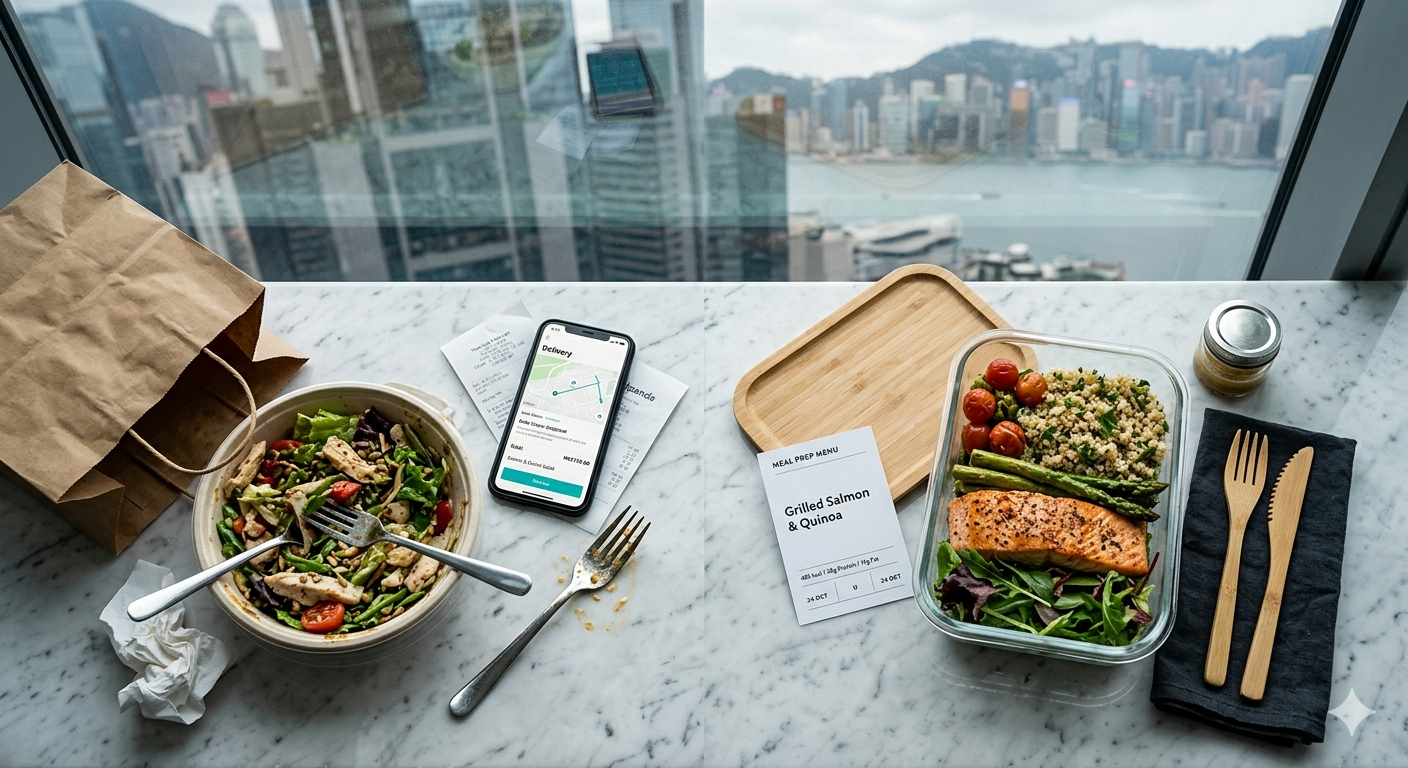
So the fair comparison isn’t meal delivery versus perfect home cooking. It’s meal delivery versus what most people actually eat: takeaway and restaurant food with no information at all.
What a diabetic-friendly meal plan should include
Plenty of services put “diabetic-friendly” on a menu. Here’s what it should actually mean.
1. Consistent carbs. The amount of carbohydrate in each meal should be roughly the same from day to day. If Tuesday’s lunch has 20 g more carbs than Monday’s, your readings, and for some people their medication, stop lining up.
2. Better carbs. Wholegrains, legumes, brown or mixed rice and lots of non-starchy vegetables should be the default, not refined white carbs and sugary sauces.
3. Protein at every meal. Protein slows digestion and softens the blood sugar rise from the carbs on the same plate. A meal that gets the carbs right but skimps on protein is only half done.
4. Some healthy fat. Olive oil, avocado, nuts and oily fish help keep blood sugar steady and keep you full, so you’re less likely to snack between meals.
5. Real nutrition support. A dietitian who can set your targets and adjust the plan is worth more than any label on a menu.
This is how our Mediterranean meal plan is built. It’s our go-to recommendation for clients managing blood sugar: low in sugar, high in fibre, low GI, with carbs kept to around 35–40% of calories and spread evenly across the day. On the 1,500-calorie option, that works out to roughly 45–50 g of carbs per meal over three meals. The Mediterranean diet also has some of the strongest evidence of any eating pattern for preventing and managing type 2 diabetes, which is why the IDF highlights it. You can read more in our Mediterranean-inspired diabetic meal plan post.
Prefer Chinese food? Our Asian meal plan can be adjusted by our dietitian. If you want more control over individual dishes, Custom Delights lets you pick your meals while our nutritionists keep the calories on target. If you’ve been told to cut carbs harder, the Gluten-Free Low Carb plan is another option. Just talk to your doctor first if you take insulin or sulfonylureas, since going very low-carb can change your medication needs.
Type 1 vs type 2 diabetes: how meal planning differs
The principles above apply to both, but the stakes at each meal are different.
Type 1: every gram counts, right now
With type 1 diabetes, carb counting isn’t a lifestyle choice. It sets your insulin dose. Your mealtime insulin is calculated from the grams of carbs you’re about to eat, so if the plate has 15 g more or less than you think, the dose is off, and you’ll feel it within hours.
Bolus calculators and insulin pumps help, and the Cureus review found carb counting combined with a bolus calculator can lower HbA1c. But a calculator is only as good as the number you type in. If you’re using delivered meals with type 1, ask for the carb count of each meal and check your readings closely for the first couple of weeks.
Type 2: same structure, longer game
Type 2 is mainly about insulin resistance. The focus is on steady, lower-GI eating, sensible portions and, for many people, some weight loss, maintained over months rather than calculated meal by meal. The ADA Standards of Care 2026 continue to put lifestyle and nutrition therapy at the centre of type 2 management.
One meal being a bit off matters less. Being consistent across hundreds of meals matters a lot. If weight loss is part of your plan, even a modest amount can make a real difference, according to the IDF. Our diet assessment tool can estimate a sensible daily calorie target to start from.
What both have in common
Whether you have type 1 or type 2, you need meals with known carbs, steady portions and as little guesswork as possible.
How to make a meal plan work for your blood sugar
Here’s how to get the most out of a delivered meal plan, step by step.
1. Get your carb target first. Ask your doctor or dietitian what range of carbs per meal suits you. It depends on your medication, activity level, weight and history, so there’s no single right number. You can also book a consultation with our dietitian, and the fee is refunded if you join a program of two weeks or more.
2. Check that the carbs are consistent. Ask any provider, us included, for the carb content of the meals and how much it varies. If lunches swing by more than 10–15 g from day to day, carb counting gets difficult.
3. Use your delivery time as your routine. Our meals arrive every morning between 7:00 and 10:30am, or the evening before if that suits you better (delivery details). Treat that as your fixed meal schedule and plan the rest of your day around it.
4. Test after new meals. Everyone responds a bit differently, even to meals with the same carbs. Check your blood glucose 1–2 hours after each new dish for the first few weeks. You’ll quickly learn which meals suit you best, and our dietitian can adjust your plan based on your readings.
5. Choose fresh over frozen, and a service with real people behind it. Look for fresh cooking, a choice of calorie levels and access to a dietitian. At Eatology, meals are cooked and delivered the same day in our Kennedy Town kitchen, never frozen, and our in-house dietitian sets your targets.
Key takeaways
- Managing diabetes through diet isn’t about eating less. It’s about eating more consistently.
- Carb counting works. Lower-GI carbs, sensible portions and regular meal times all help.
- In Hong Kong, the hard part is eating out with no idea what’s in your food.
- A well-designed diabetic meal plan, delivered fresh, takes the guesswork out of every meal.
If that sounds like what you need, have a look at our diabetic-friendly Mediterranean meal plan, browse all our meal plans, or book a chat with our dietitian first. Free delivery across Hong Kong Island and Kowloon.
FAQs
Can people with diabetes eat rice?
Yes. The key is portion size and what you eat with it. Keep the rice portion moderate, choose brown, mixed or basmati rice when you can, and eat your vegetables and protein before the rice.
How many carbs should a diabetic eat per meal?
There’s no single number. It depends on your medication, weight, activity level and blood sugar targets. Your doctor or dietitian will give you a range, and a good meal plan should be built around it.
Is there a diabetic meal delivery service in Hong Kong?
Yes. Eatology’s Mediterranean meal plan is designed for blood sugar control: low sugar, high fibre, low GI, with carbs spread evenly across the day. It’s delivered fresh every morning, and our dietitian can adjust it to your targets.
Which noodles are best for diabetics?
Mung bean glass noodles (粉絲) have one of the lowest GI values of any noodle. Instant noodles and many white rice noodles are much higher. Portion size still matters, whichever you choose.
Is meal delivery safe if I’m on insulin?
It can make things easier, because portions are consistent. Ask for the carb content of each meal, check your glucose after new dishes, and talk to your doctor before changing your routine.